
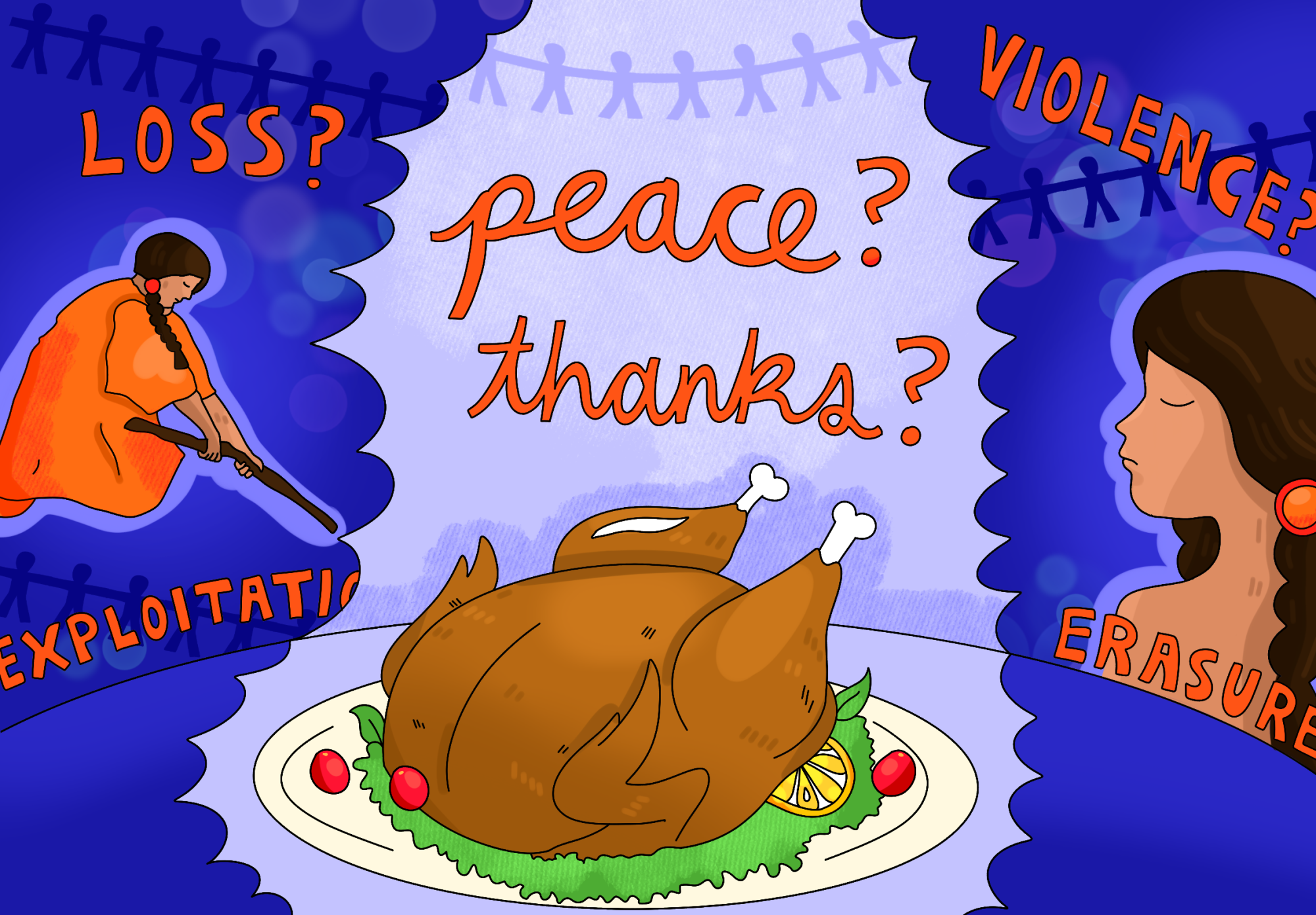
As the leaves shift from green to red, the humid air gives way to a cool breeze, and Jack-O-Lanterns on front porches are traded out for plastic turkey figures, there is no doubt that Thanksgiving season is underway.
Thanksgiving is one of the few days of the year where it is encouraged for all to come together and spend quality time with loved ones. For many, this means sitting at your family’s dining table, surrounded by the lingering scent of turkey and stuffing. Or perhaps, on a larger scale, watching the Macy’s Thanksgiving parade live on television. Either way, it is these moments that the citizens of America cherish.
What Americans do not associate with Thanksgiving, however, is the brutal decimation of Native American culture, tradition, and identity. In a 2022 Smithsonian Magazine article, “Thanksgiving from an Indigenous Perspective,” writer Dennis Zotigh explains how “the Thanksgiving myth has done so much damage and harm to the cultural self-esteem of generations of Indian people, including myself, by perpetuating negative and harmful images to both young Indian and non-Indian minds.”
Thanksgiving, at its core, was intended as a day of gratitude within our community to celebrate the establishment of the harvest; the God-given blessings we have in life. Historically, it traces back to 1621, when the pilgrims feasted to mark their first successful harvest in the New World. However, history textbooks often glaze over the fact that another group of people attended this meal — Native Americans.
When the pilgrims first arrived in Plymouth, Massachusetts in 1620, they struggled to survive on the foreign land. The Native American tribe inhabiting the land, Wampanoag, was quick to help the newcomers. During this first year of settling in, members of the Wampanoag tribe taught them how to grow crops, fish, and hunt animals. Most modern-day Americans often forget that they were an instrumental part in the development of the first American society. We often forget that amidst the notion of American “freedom”, a tribe was excavated out of their own land as a result of European settlement expansion. We often forget that America itself was the perpetrator in a story that is meant to celebrate collaboration and gratitude on our behalf.
So what does this mean for us today? Don’t get me wrong, I look forward to a happy, hearty Thanksgiving each year spent with family and friends, and by no means do I think that we should cancel the festivities. However, truly honoring Thanksgiving also means acknowledging the full story behind the holiday, and there is one place that acts as a perfect opportunity to to get the facts straight; school.
According to Mr. Rowley, United States History teacher at HPHS, “When I was a kid, Thanksgiving was taught in a really basic way where it was just about pilgrims and Native Americans just having a nice meal together. Now, I do my best to educate my students, teaching them that not all of those interactions were peaceful by any means. With the understanding of that history, I feel that we as Americans should have a day to reflect on the positivity in our lives and the things that we are grateful for.”
It is clear that the holiday of Thanksgiving is more than just dinners and festive traditions, it serves as an opportunity to honor our history and those who came before us. Native Americans played a vital role in the survival of our first settlers, yet their contributions have been overlooked for hundreds of years. We, as a society, must now celebrate Thanksgiving with both excitement and awareness, acknowledging this holiday as one that honors the past, can be enjoyed in the present, and remains in constant pursuit towards a more educated future.