
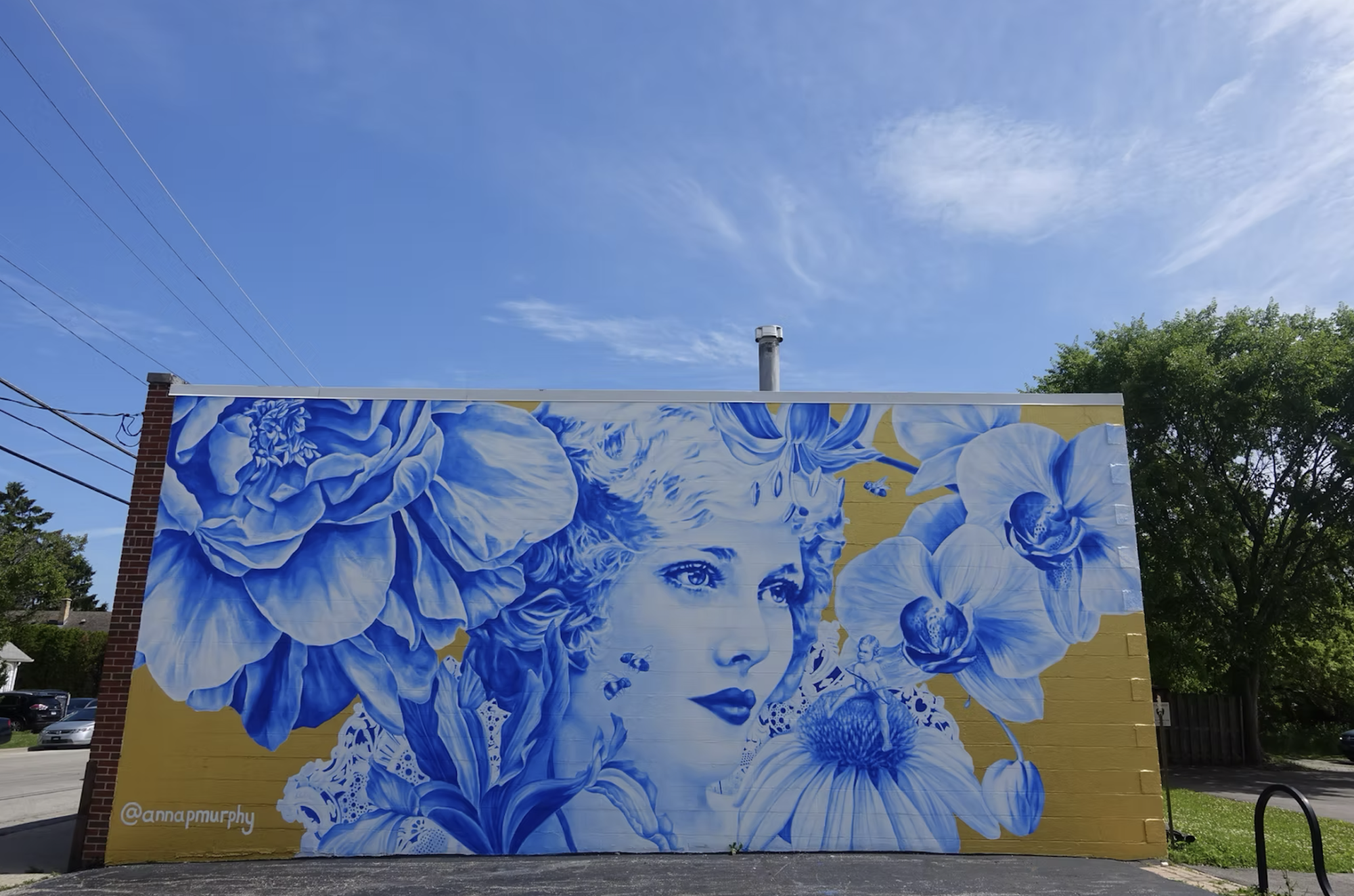
On June 6, 2024, the Highwood International Mural Festival sprang to life in the City of Highwood. As you made your trip down 244 Wakuegan Avenue, you may have seen Al Diaz, one of the many world-renowned artists commissioned from around the country by Laura Lulu Reich and her fiancé, Chris Kozloff, painting a mural. With bright colors and moving images, these murals aren’t just there for decoration; they are there to foster community.
Celebrate Highwood had created the annual Pumpkin Festival years prior, and they were rearranging it to use it as a way to heal the wounds left by the recent Fourth of July parade shooting. Similarly, James Lynch, the Executive Director of the Arts Center in Highland Park, felt inspired by an exciting new possibility during his visit to Brooklyn, New York, where he noticed all the murals adorning the city, paving the way for him to contribute to healing on his own terms.
With his new idea, Lynch decided to give Laura Lulu Reich a call. Laura Lulu Reich of Astoria, New York, is an art dealer, former gallery owner, 1999 Highland Park High School graduate, and the co-curator of the Highwood International Mural Festival. During his call with Lulu, Lynch explains that “Laura Lulu Reich was so upset after the shooting –she wanted to give back– and we got to know each other. I said ‘Next time you’re in town, come see me’ and she did, and she showed me all of the artists that she was connected to”.
If there were a word to describe Lulu, it would be passionate. Through her unrelenting commitment to her cause in “giving back to the community”, —-her hometown, Highland Park—after the tragedy, she recruited six renowned artists that she had met in New York to come down and paint Highwood, live. The artists from New York included Al Diaz, Chris RWK, Zimad, Eelco van den Berg, DontFret, and Epic Uno. Others not from New York included Anna Murphy, Asend, E Lee, Ruben Augirre, Stuk One, and Wane Cod. Then came James’ job.
James Lynch met with Eric Falberg, owner of Distilling Company 28 Mile and Alderman of Highwood, who helped him organize a meeting in which Lynch acted as the intermediary between Lulu’s dreams and the City Council of Highwood, including the Beautification Committee. “Eric Falberg was the first one I brought it to,” Lynch said. “He just makes things happen. If he hadn’t been involved with my idea, this never would have happened. And the rest of the city council and Celebrate Highwood team really stepped it up. Without them, nothing would have happened”.
After the council approved their idea, Lynch began looking at over 20 possible places to place the murals while Lulu and Kozloff put together a permissions proposal for each place. The social cohesion of each contributor had become a vital part of their success. Soon, the dream that was the murals became a reality. 12 murals can be found at 244, 250, 341 Wakeegan Avenue, 431, 440, 514 Sheridan Road, 552, 440 Bank Lane, 122 North Ave, 334 Green Bay Road, and 102 Highwood Avenue. “Each one has an easter egg- the artist may throw something in a little fun– but most of the time, each artist has a vision –something beautiful– that they want to share. But there is always a little something in there you don’t get unless you’re the artist or they tell you”, Lynch said.
The Highwood Mural Festival was founded in 2024, and the ideas and realizations this event brought with it raised more questions and possibilities for the future of the city. It not only brought beauty to the surroundings of Highwood but also unveiled attitudes about art within Highland Park and much of the world. After all, this festival was first pitched to Highland Park, Lulu’s hometown.
. “Highland Park has a somewhat restrictive policy towards murals –they don’t fund them through any city incentive program, so they all have to be done by private individuals, so it takes longer to take off, “ Lynch explains. “In Highland Park, we have a policy that if you’re going to propose a mural in an area, you have to tell everybody who has a business or lives within a certain area and then meet them in a public space and talk about the proposed mural and get feedback”.
Lynch noted that Highland Park is “reluctant and slow-moving to get a project like this off the ground”, while Highwood “fast-tracked it right away”, supported by its organization, Celebrate Highwood, whose goal is to embrace the culture of Highwood by bringing fun and interesting things into it. But why is there such a stark difference?
“People are afraid”, Lynch said.
“People have a misconception about what art can do or will do,” Lynch clarifies. “They are afraid that it might mean something objectionable. But what if they paint something wonderful? When I was trying to promote the idea of the festival to the city council, I had asked ‘What is so objectionable about a beautiful flower’”?
Often, murals are compared to graffiti, seen as dangerous or offensive, or as a leisure activity that artists do for fun or for free. Lynch contradicts these ideas by highlighting the economic “transformation” the mural festival has had on Highwood. Already known for its bars and restaurants, Highwood has now, because of the mural festival, become an official arts destination on the map. In turn, it has become a hotspot for tourists and artists traveling to see the murals and will soon bring a horde of other businesses into the community and local economy, taking a step up in both its economy and its identity.
He also counters that, although the ‘objectionable’ part of the murals lies in their possibility to have political statements made in the process of their creation, doing so goes against the mural guidelines of Highwood and Highland Park, which therefore differentiates it from graffiti.
Lynch hopes to encourage Highland Park to “embrace its identity as an arts town” with new plans to further the arts in Highland Park. “Between the city council, Celebrate Highwood, and Lulu and Koz (Kozloff), there’s more that we want to do next year,” Lynch said. “I’d like to do murals in between buildings in the alleys. I’m working on presenting this project idea to a bunch of stores in Highland Park and business owners on the storefront, and seeing who wants to try it out. Little by little, we’ll get it into Highland Park”.
And the thing is, the art is there; it always has been. After all, as Lynch points out, “we have music, we have dance companies, we have Ravinia music festivals. It’s just the most magical place”.
But amid all these sudden developments within our society, and the pressures of everyday life, we tend to forget it is there. “Most of the people up here have higher education and appreciation and exposure to the arts, but everybody thinks you have to go to Chicago for it”, Lynch explains. “I would like to create a more sophisticated level of exposure to the arts around Highwood, Highland Park, and Deerfield. For this area to be the hub of all things arts and culture on the North Shore is a gift to the community”.
In this way, a change of perspective is promoted: art becomes less about competition between art companies and more about bringing us closer to a more vibrant society. Lynch adds that, contrary to popular belief, art is not vital for us only for the beauty and inspiration it brings, but for other reasons, such as promoting the lives of younger generations. For example, students who have art classes and learn techniques within the arts have been shown to perform better in every other subject.
Lynch addresses those who think art is a pastime and that science and math careers are better: “People who believe that are missing all the other things –the way it activates your brain, the way it causes people to communicate better. Art teaches creative problem-solving and enhances creativity. It’s sort of like being all left-brained or right-brained. You want to activate both sides of your brain to be a full, complete human being. So art is just as important to learn as math and science”.
Not only is art beneficial for one’s intelligence, but in an epidemic of loneliness, the arts can be a catalyst for connection and healing. To Lynch, art is “‘to hammer every problem as a nail.’ For me, art is the way into everything. It can help people get through difficult times”.
Lynch explains that the reason people get disheartened so easily is because “the world’s a tough place to live. And you need something to keep rekindling that spirit of what is possible. It is a whole different world, a way to recharge your batteries. That’s what the arts do”.
Referencing the magazine Psychology Today, Lynch says that “one of the greatest illnesses facing everybody right now is loneliness”, and this idea of loneliness is magnified after the recent Highland Park shooting, the very reason the mural festival was founded in the first place. “Everything is related to the shooting for me,” Lynch said. “My friend, who is a trauma therapist, said, ‘The arts have the ability to achieve a therapeutic effect without actual therapy’”.
This festival has presented itself as a perfect example of art’s ability to create a haven of connection and promote feelings of togetherness and safety within this community, especially in times of distress, such as that of the recent shooting. This takes physical form in the documentary engineered by Kozloff, Lulu, other contributors to this festival, and Highwood citizens.
The documentary, titled “More Than Paint”, represents how bringing 12 world-renowned artists together to collaborate and bring color to a healing community connects not only the viewers to the paintings, but to each other, reinstilling trust and a sense of belonging between them and driving a lasting transformation to the city. “A lot of people in Highwood stopped by; we had a little booth up there by the art center, and they stopped by to thank us. And everybody –when the movie was showing– they were clapping, and cheering for it”, Lynch said.
Lynch reflects the power of these murals within the community; “The way I think of it is, those images and what they achieve for this community is not just a pretty picture on a wall. It brings a community together and gives them a sense of belonging. It encourages people, it inspires people; it really brings everyone together. And it redefined this community in such a way. It wasn’t just what the paint does- it is the ideal that came with it.”
Please note that if you are still suffering from the mental impact of the Fourth of July parade or any other circumstances, The Arts Center in Highland Park has a group called The Art Impact Project that comes together every month and offers a free art session.