
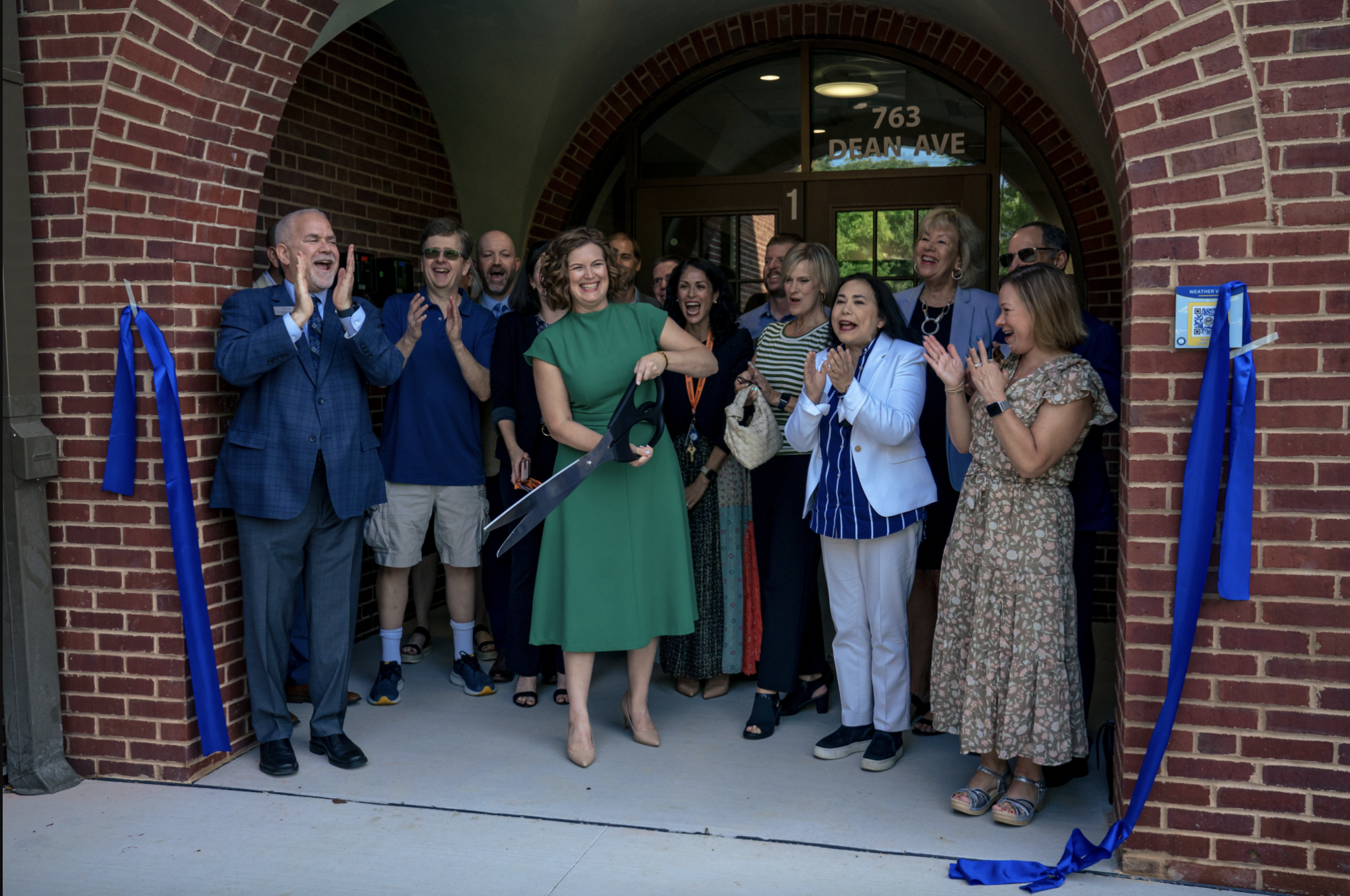
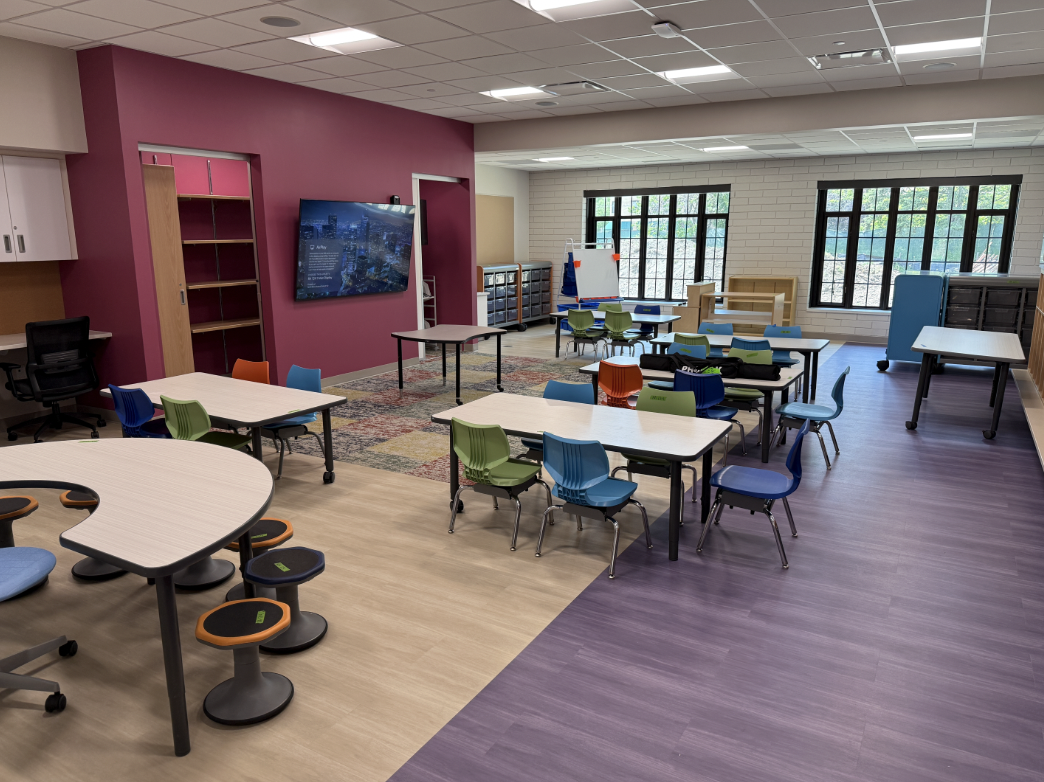
On August 15, 2025, District 112’s superintendent, Michael Lubelfeld, and Director of Communications Ben Finfer stood together alongside Ravinia Elementary School’s principal, Courtney Gilkison, to cut a ribbon that would signal one end and simultaneously a new beginning. The renovations for Ravinia Elementary school were finally finished, and the doors were finally open to a community that had used its voices to advocate for change — and had succeeded.
A comprehensive assessment of elementary and middle schools’ physical and educational conditions was conducted in 2018, and the then 120-year-old schoolhouse of Ravinia had failing marks across nearly the entire board. At the time, it offered little to no air heating or conditioning, had outdated incandescent and fluorescent lighting, and utilities that had long reached the end of their shelf life. When new Superintendent Michael Lubelfeld of North Shore School District 112 first came to Ravinia, he held firmly the belief that “the schools are built for the youth, and they deserve to be in spaces and environmental conditions that allow them to create the jobs in the future that we don’t even know the name of yet.” In contrast, the mood and educational quality at Ravinia Elementary were low. He knew there needed to be a change.
With a daring and novel approach, Dr. Lubelfeld created the Long Range Facilities Committee — a precursor that would later become the Citizen Task Force, a group of roughly 45 parents, business owners, and citizens. Using the Task Forces’ ideas, Principal Gilkison and Dr. Lubelfeld funded phase 1 of their renovation plans through non-referendum bonds, although this only covered two of the schools. They hosted a public referendum in 2022, an event in which the taxpayers or citizens vote for or against a proposal, and which would mark one of the biggest turnovers in district history. A striking 72% had voted for the renovations, highlighting how valued the voices of the Ravinia community are.
Not only do the results of this voting speak to the prioritization of community opinions, but is also “a real testament to how much the community cherishes this particular school and public schools in general too,” Mr. Finfer said. As quoted by a visiting former superintendent and principal, this feat was a “perfect example of taxpayers well spent.”
The approval funded 108 million dollars for renovation, including a significant amount dedicated to the renovation of Ravinia. Once the plan was approved, no time was wasted, and the 20 months of construction began. During this time, students at the school were relocated to Green Bay School in Downtown Highland Park. Wight and Company was the designer, while Trane Technologies worked with energy, and Gilbane Construction managed the architecture. Lubelfeld and Gilkison were part of the task force, responsible for checking progress and assuring planning was going well. Ben Finfer made sure the community was well-informed on the progression of the renovations and could give feedback.
Despite the impressive end result, there were some bumps, including the slowing down of the project by the technicalities of making one of the first dynamic direct closed-loop geothermal HVAC heating and cooling systems in North America. This environmentally sustainable and conservational mechanism heats and cools the school using the natural temperature control of the earth as opposed to electricity to power itself, never interacting with the water system. Although difficult, the process was only “another example of the community’s commitment to sustainable energy, green energy, and financial sensitivity, which will over time save taxpayers 30-50% utility costs, task rebates,” Superintendent Dr. Michael Lubelfeld explained. “We are life-long learners”.
Despite the tremendous results of the referendum vote, there were some concerns about the renovations.
“I think there were initially some worries and questions about maintaining that historical integrity,” Principal Gilkison said, referencing feedback she had heard from some of the students.
Architects had come out during school lunch and recess to talk to students about what they wanted to see, not only their parents. Mr. Finfer, Mrs. Gilkison, and Dr. Lubelfeld all emphasize the importance of communicating with and receiving feedback from the students.
To address the fear that the school’s unique identity would be lost, administrators took a layered approach to create a school that both shared nods to the past and hints of the future. Susan Benjamin, a detail-oriented historian, who worked with White and Company Architects, the architectural style of vaulted ceilings and wood trusses would still reflect that of Van Bergen from 1913. Along with maintaining the artistic integrity of the building, she kept five fireplaces, four repurposed as bookshelves and added on another one in 1998. War-era Robinhood paintings from The New Deal and the Works Progress Administration adorn the aged walls to respect the artistry and history of that time. Pointing to a 1913 preserved brick wall behind a modern staircase, Lubelfeld called it one of the many examples in this building of “a juxtaposition of the new and the old”. This juxtaposition, instead of an obstacle to historical integrity, became the very thing that brought the community together.
“I think that’s what sold them on it — yes a lot of new, but because so much of the history was preserved, they were okay with it,” Mr. Finfer said.
Not only did the combined efforts of administrators receive positive feedback, but opened up accessibility within the school. Principal Gilkison reflects on when a student once came to her office with a persuasive letter asking for a change in the lack of accessibility of the school, the stairs being required to get into certain parts of it. This ultimately sprouted in the now Americans For Disability ACT (ADA) compliant 2025 Ravinia Elementary School. The school is now able to host a larger student population with a more inclusive special education approach in one accessible building. In addition, the Ravinia Elementary School playground is an ADA-compliant playground, the second of what will hopefully be many more in the district. Mr. Lubelfeld highlights it is because of schools like Ravinia that “students in your whole generation understand that all of us matter. We’ve got to create spaces that show that we all matter, whether we are adults, or children, or youth.” In showing care for all types of individuals regardless of ability and generation, Ravinia establishes this important precedent; we all belong here.
“I believe the heart of Ravinia is in this community,” Principal Gilkison said. “Ravinia is a walkable school, built as the center of the community, and what has been so special about this school is the way that it brings people together. We have grandparents and great-grandparents who went to school here and still live around the corner. It is an identity, from the Rocky Racoon weathervane perched atop its new roof to its now 128-year-old foundation. Ravinia alumni stop by all the time to see their name on a brick on the ground, or the tree that someone planted when they graduated in 1944. It happens every few weeks. That sense of belonging is what makes this community so special.” Ravinia, in its historical preservation, leaves room for past generations to reflect.
Ultimately, in the midst of all this change and seemingly surface-level renovations, a deeper message appears.
“While you’re in the most modern structure on the North Shore, the most beautiful elementary school anywhere, there’s a nod to history through every nook and cranny of this facility” Dr. Lubelfeld said.
These renovations and its intergenerational structure, then, become less about looks and efficiency, but more about the mindset that goes with it.
“We all benefit from this space and we all belong here,” Principal Gilkison said. “And now we have something physical to show with it”.
“The future of our free society is built upon public schools and education,” Dr. Lubelfeld said. “We have an economic imperative as a people to shore up the public schools so that we can make sure we have an economic future in the United States.”
This is a quality currently lacking as many of the youth are categorized as disadvantaged. This number will only grow as time moves on unless future students are enabled to receive a quality education. This will require not only having their voices heard, but also for them to be learning in quality environments, both physically and mentally. If this is preserved, the inclusive values that make up the foundation of Ravina Elementary are also preserved.